
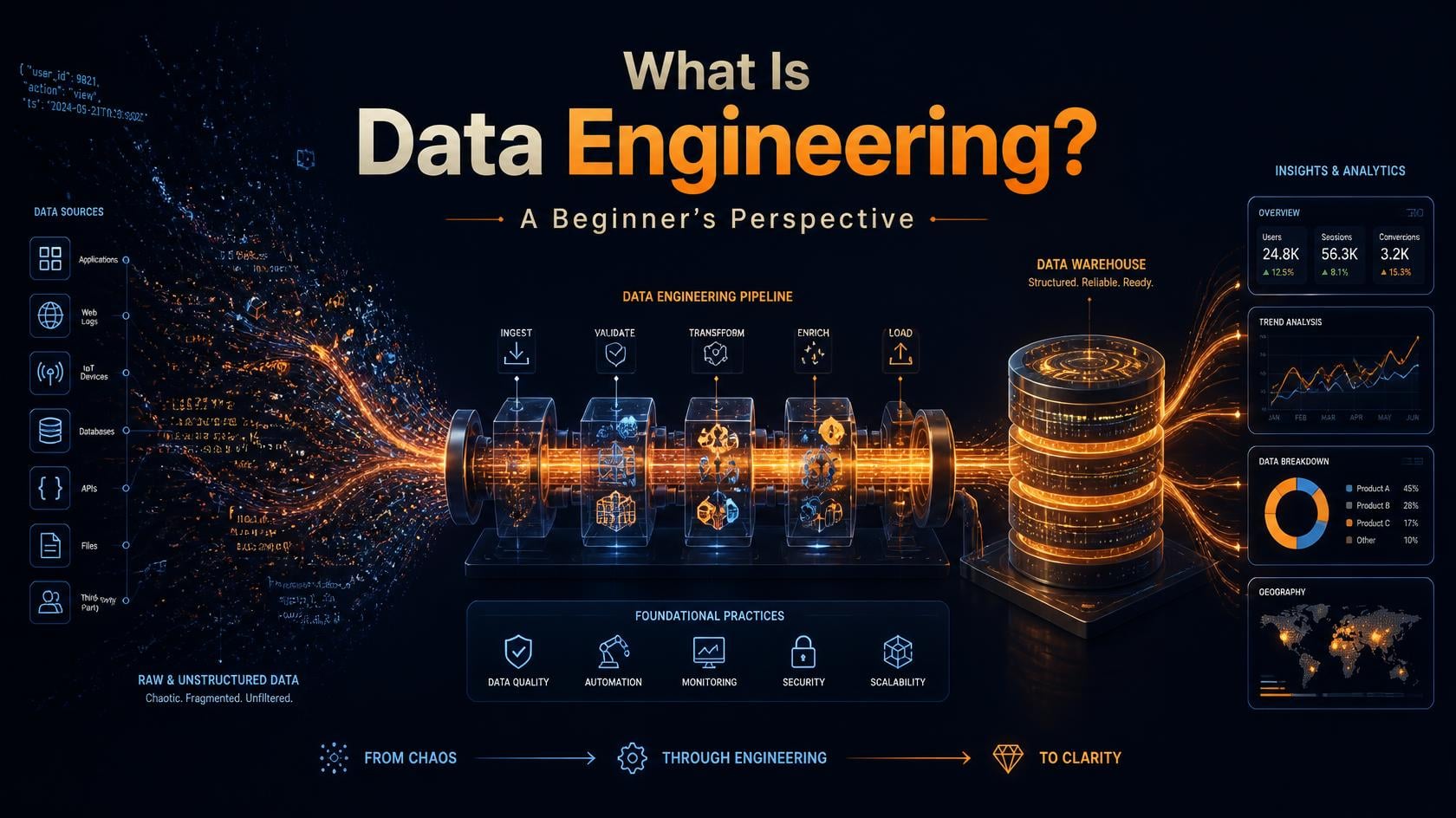
Have you ever wondered how companies handle millions of pieces of data every day? Let's explore the work happening behind the scenes.
Imagine opening YouTube to watch a programming tutorial. You search for a topic, and within seconds, YouTube shows you relevant videos. It also recommends similar content based on what you've watched before.
Now imagine millions of people doing the same thing every second. All those searches, videos, likes, and comments generate enormous amounts of data.
But here's an interesting question: How do companies collect all that data, organize it, and make it useful?
That's where Data Engineering comes in.
1. What Exactly Is Data Engineering?
In simple words, Data Engineering is about building systems that collect, process, organize, and deliver data so that people and applications can use it.
Think about an online shopping website. Every time someone searches for a product, adds something to their cart, or places an order, the system generates data. That information can help the business understand customer behavior, track sales, and manage its inventory.
However, raw data doesn't always provide useful answers immediately. It might contain missing values, duplicate records, inconsistent formats, or information scattered across different systems.
Before the business can use that data effectively, someone needs to prepare it and make sure it is reliable.
A Data Engineer builds the systems that make this possible.
You can think of Data Engineering as building the roads that allow data to travel from where it is created to where it is needed.
2. Why Is Data Engineering Important?
Today, almost every industry generates data. Banks process transactions, hospitals manage patient records, universities maintain student information, and e-commerce companies record customer orders.
But collecting data is only the beginning. Businesses need reliable ways to turn that information into something useful.
For example, imagine a supermarket wants to know which products sell the most during the holiday season. The information might be stored across multiple branches, databases, and sales systems. If the data is incomplete or inconsistent, the final report might be inaccurate.
Data Engineering helps solve these problems by creating reliable processes for collecting, cleaning, combining, and storing information.
Good data systems help businesses:
Make better decisions using reliable information.
Generate reports without manually combining files every day.
Process growing amounts of data efficiently.
Provide clean, organized data for analytics and machine learning.
Detect data quality problems before they affect important decisions.
Without reliable data systems, even the most advanced analytics tools and machine learning models can produce disappointing results.
3. What Does a Data Engineer Actually Do?
A Data Engineer's work involves more than writing code to move information between databases. They design, build, and maintain systems that allow data to flow reliably through an organization.
Let's return to our online shopping website.
When a customer places an order, the application stores information such as the order ID, customer ID, products, quantities, and prices. A Data Engineer might build a pipeline that collects these records, checks their quality, transforms them into a useful format, and sends them to a data warehouse for reporting.
This work usually involves several important activities.
Collecting data: Data can come from databases, APIs, applications, CSV files, and external systems. A Data Engineer builds processes to bring this information together.
Cleaning and transforming data: Real-world data is rarely perfect. Engineers handle missing values, remove unwanted duplicates, standardize formats, and transform raw records into useful information.
Storing data: Data needs to be stored in an appropriate system. Depending on the requirements, this could be a relational database, data warehouse, or data lake.
Automating workflows: Instead of manually processing files every day, engineers schedule pipelines to run automatically and monitor whether they complete successfully.
Maintaining reliability: Data pipelines can fail because of network problems, unexpected input formats, or changes in the source system. Engineers investigate these issues and improve the system so that data remains trustworthy.
The exact responsibilities vary between companies, but the main goal remains the same: make data available, reliable, and useful.
4. What Is a Data Pipeline?
If you're beginning your Data Engineering journey, one of the first concepts you should understand is a data pipeline.
A data pipeline is a sequence of steps that moves data from a source to a destination. Along the way, it may clean, validate, combine, or transform the information.
Imagine a small online store that wants to generate a daily sales report. Its order information is stored in a database, but the manager wants a report showing total sales for each product.
A simple pipeline might work like this:
Order database → Extract data → Clean and transform → Store results → Generate report
First, the pipeline extracts the order records from the database. Then it checks for problems, standardizes the data, and calculates the required totals. Finally, it stores the prepared results where the reporting system can access them.
This process can happen automatically every day.
Two common approaches to building data pipelines are ETL and ELT.
ETL (Extract, Transform, Load): Data is extracted from its source, transformed, and then loaded into the destination.
ELT (Extract, Load, Transform): Data is extracted and loaded into the destination first, then transformed there.
Both approaches are widely used. The best choice depends on the architecture, tools, data volume, and business requirements.
Once you understand pipelines, many other Data Engineering concepts become easier to connect.
5. How Is Data Engineering Different from Data Analytics and Machine Learning?
When exploring technology careers, you might come across Data Engineering, Data Analytics, and Machine Learning. These fields are connected, but they focus on different problems.
Imagine a food delivery company wants to improve its delivery service.
The Data Engineer builds pipelines that collect and prepare information about orders, restaurants, customers, and delivery times. The Data Analyst uses the prepared data to investigate questions such as why deliveries are delayed or which restaurants receive the most orders.
Meanwhile, a Machine Learning Engineer might build a model that predicts how long a delivery will take based on historical data and current conditions.
In simple terms:
Data Engineering: Builds the systems that prepare and deliver data.
Data Analytics: Uses data to understand what happened and why.
Machine Learning: Develops systems that learn patterns from data and make predictions.
These roles often work together. A machine learning model, for example, may depend on the pipelines and prepared datasets created by Data Engineers.
This is one reason Data Engineering is an important part of the wider data ecosystem.
6. What Tools Do Data Engineers Use?
When you first explore Data Engineering, the number of tools can feel overwhelming. You might see SQL, Python, Spark, Airflow, AWS, Azure, Snowflake, and many other technologies mentioned in job descriptions.
The good news is that you don't need to learn everything at once. Start by understanding what each category of tool is designed to do.
SQL is used to retrieve, filter, join, and summarize data stored in databases. It is one of the most important skills for a beginner because data engineers frequently work with structured data.
Python is useful for processing data, automating tasks, working with files, and building pipelines. Its libraries make it easier to handle common data processing tasks.
PostgreSQL is a relational database that provides an excellent environment for practising SQL and learning how structured data is stored and queried.
As you progress, you can explore more specialized tools. Apache Spark helps process large datasets, while Apache Airflow helps schedule and monitor workflows. Cloud platforms such as AWS and Microsoft Azure provide services for storing and processing data at scale.
Data warehouses and platforms such as Snowflake and Databricks also appear in modern data systems.
Rather than memorizing tool names, focus on understanding the problems they solve. Once you understand the fundamentals, learning a new tool becomes much easier.
7. How Can a Beginner Start Learning Data Engineering?
If you're starting from the beginning, you don't need to build a complicated cloud system on your first day. A small project can teach you many of the fundamental ideas.
Start with SQL and learn how to query, filter, group, and combine information from different tables. Then learn Python, focusing on basic programming, file handling, and working with structured data.
Next, explore relational databases and data modeling. Understand how tables are related, why primary and foreign keys matter, and how to organize information effectively.
Once you have these foundations, try building a simple data pipeline.
For example, download a public dataset containing sales records. Use Python to read the CSV file, identify missing values, remove duplicate records, and calculate useful statistics. Then load the cleaned data into PostgreSQL and write SQL queries to answer business questions.
This small project introduces several essential Data Engineering skills without requiring expensive cloud services or complicated infrastructure.
A practical learning path looks like this:
Start: SQL, Python, and PostgreSQL.
Build your foundation: Data cleaning, data modeling, and database concepts.
Build projects: Create automated pipelines using real datasets.
Move forward: Learn data warehouses, cloud platforms, and workflow orchestration.
Explore advanced topics: Apache Spark, distributed processing, monitoring, and pipeline optimization.
The important thing is to practise as you learn. Reading about a technology helps you understand its purpose, but building something with it helps you understand how it works.
8. Your First Data Engineering Challenge
Let's finish with a small challenge.
Imagine you're building a data system for an online store. The store has three CSV files: customers.csv, orders.csv, and products.csv.
The business wants to know which products generate the most revenue.
Before answering that question, you need to think about how the data should be processed.
Consider these questions:
How would you check whether the files contain missing or duplicate records?
How would you connect each order to the correct customer and product?
How would you calculate the total revenue for each product?
Where would you store the prepared data so that it can be queried easily?
How could you automate the process to run every day?
You don't need to know all the answers yet. The purpose of this challenge is to start thinking about the complete journey of data, from raw files to useful results.
As you learn SQL, Python, and databases, you can gradually build this system yourself.
Data Engineering might seem complicated when you first encounter all the tools, technical terms, and architectures. But the central idea is quite simple: data needs to move from where it is created to where it can create value.
A business may collect millions of records, but those records are much more useful when they are accurate, organized, accessible, and ready for analysis.
Data Engineering is about building the systems that make that happen.
You don't have to become an expert overnight. Start with the fundamentals, experiment with small datasets, and build projects that help you connect theory with practice.
I'm exploring this field one concept at a time, and this article is a starting point for understanding what happens behind the scenes when data becomes useful.
If you're learning Data Engineering too, remember that you don't need to know everything before you begin. You just need to take the next step.
More from Code & Coffee — learning technology, one cup at a time.
About the author
Hey there! I'm a tech enthusiast, developer, and lifelong learner who loves exploring the world of code over a good cup of coffee. ☕💻 Whether it’s software development, AI, DevOps, or debugging tricky bugs, I enjoy sharing insights and learning along the way.
Join me on Code & Coffee as we break down complex tech topics, one sip at a time! 🚀
Comments
Join the discussionNo comments yet. Be the first to comment.
Beyond The Data
Explore the world of Data Engineering, from beginner-friendly fundamentals to advanced concepts. Learn about SQL, Python, data pipelines, data modeling, cloud platforms, and big data technologies through practical examples, hands-on projects, and lessons from my learning journey.


